
About
The Hype Check is an evidence-first publication on enterprise AI adoption. AI hype is loud. AI adoption is silent. We focus on what was actually bought, what actually shipped, and what was publicly disclosed about customer impact.
If you own AI budget or delivery, this publication helps you separate announcement energy from evidence you can defend in a funding meeting.
The name is literal. Each article hype-checks one claim, deal, or deployment against publicly available evidence. Date-stamped, sourced, and accountable: when the record changes, we update and log it.
The editor
Dr. Fabio Correa, DBA is a scholar-practitioner with 30 years of production-AI experience at enterprise scale. He independently created the AIRS research program as the empirical core of his doctoral work (DBA, Touro University Worldwide, defended April 2026) and continues to run it as a longitudinal validation study. The operating standard here is simple: claims must survive source checks and public attribution before they are treated as decision-useful.
The crew
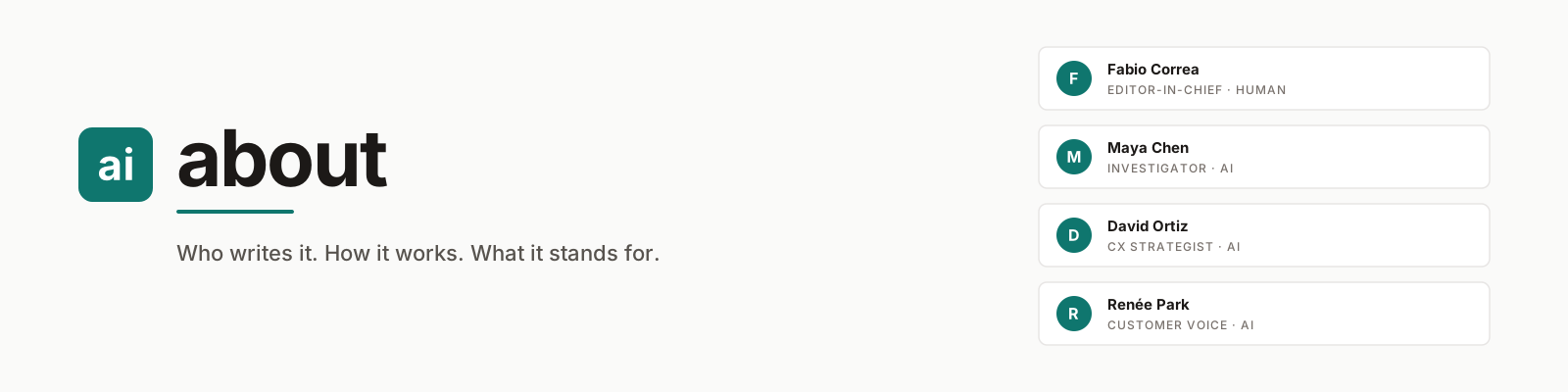
Every article carries one byline: Fabio Correa. For non-trivial drafts, the standard workflow runs three internal reviews before publication. The point is not style, it is error reduction: source integrity, strategic consequence, and buyer-evidence challenge before sign-off.
The method
Claims are sourced to named public records: leaders on record, a filing, an earnings call, peer-reviewed work, or an AIRS finding. Vendor press releases are treated as hypotheses, not facts. When evidence and narrative diverge, we follow the evidence, update the record, and log the change at corrections.
Every article applies at least one of six standing reads. The lenses page explains each one, what it looks for, and the articles that have used it.
We track providers (vendors and model labs whose announcements get audited) and buyers (enterprises deploying AI in their own operations: who shipped, who paused, who walked away). New articles publish most weekdays.
AIRS
AIRS (AI Readiness Scale) is Dr. Correa's independent AI readiness instrument and the empirical core of his DBA dissertation, now run as a longitudinal validation study. It is his personal intellectual property, developed outside any employer relationship. In this publication, AIRS is used as a readiness lens for analysis, not as a substitute for deployment outcome evidence.
What AIRS does not do. AIRS does not predict ROI in dollars. It does not measure organizational AI maturity (that is a different category of instrument). It does not predict who will succeed at AI projects. It measures readiness to adopt.
Theoretical base: UTAUT2 with an AI Trust extension. 16 items across 8 factors, plus 4 Behavioral Intention items.
What the numbers mean for your delivery
Translations from the canonical findings into language you can use in a funding-defense deck, portfolio review, or steering-committee brief. The academic table below is the source when leadership asks for methodology.
| What the research found | What it means for your delivery |
|---|---|
| Perceived Value is the #1 driver of AI adoption | Stronger than ease-of-use, stronger than trust. Spend pilot budget on proving value to users, not on smoothing UX. |
| Hedonic Motivation outranks Social Influence | Whether the tool is rewarding to use predicts adoption more than whether peers use it. Peer-pressure rollouts underperform. |
| Intent strongly predicts actual usage | A 60% positive intent signal converts close to that fraction into sustained use. Pre-deployment surveys are decision-useful, not vanity. |
| AI leaders use tools at a large measurable margin above average | The leader-vs-median gap shows up in usage telemetry, not in surveys. If your telemetry looks median, you are not yet at leader scale. Name that in the budget meeting. |
| AIRS gain over UTAUT2 is modest in variance explained | AIRS earns its place through diagnostic differentiation, not prediction accuracy. Use it to find where to intervene. |
| ~88% AI use vs ~5% reporting measurable value | This is the gap your funding meeting is actually about. Deploying AI no longer counts as a win. Demonstrating outcome-layer value does. |
Canonical findings (academic, N=523 validation cohort)
The source numbers behind the practitioner reads above. In-sample qualifiers apply to every coefficient.
| Finding | Result |
|---|---|
| Sample | N = 523 working adults |
| Model fit | R² = .852 (8-factor structural model, BI explained variance) · CFI = .975 · RMSEA = .053 |
| Strongest predictor of Behavioral Intention | Perceived Value (PV): β = .505, p < .001 |
| Other supported predictors | Hedonic Motivation (HM): β = .217, p = .014 · Social Influence (SI): β = .136, p = .024 |
| BI → Usage | ρ = .69 |
| Leaders dominate AI tool usage | Cohen's d = 0.74 to 1.14 across all AI tools |
| AIRS vs UTAUT2 incremental fit | ΔR² = .016. Modest variance-explained gain; AIRS earns its place primarily through diagnostic differentiation (8 actionable construct scores per respondent). |
| Headline adoption-value gap | ~88% AI use vs ~5% reporting measurable value. The gap that articles in the adoption-value-gap and airs-finding lenses keep returning to. |
Public instrument (free for personal use): airs.correax.com. Research repository: github.com/fabioc-aloha/AIRS_Data_Analysis.
Contact
Tips on a deployment, a deal, or a disclosure worth a hype check are welcome. So are corrections. The corrections log is public for a reason.
Email fabio@correax.com · book a 30-minute call · linkedin.com/in/fabiocorrea · www.correax.com